

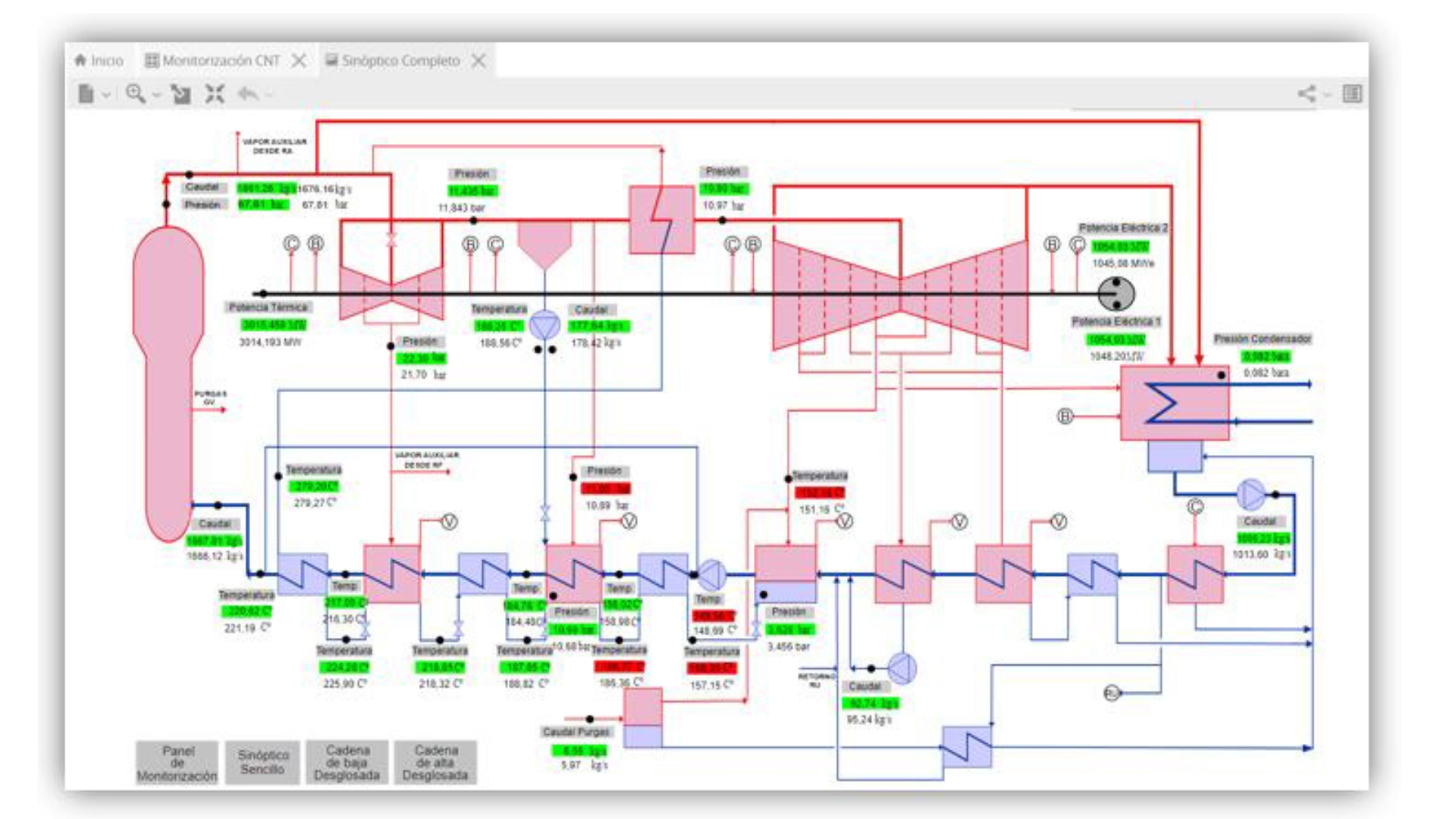

The integration of these theoretical models with plant data acquisition systems has marked a significant milestone in the evolution of nuclear power plant monitoring and maintenance. This convergence has made possible the development of innovative projects within Empresarios Agrupados, giving rise to an application that offers a real-time and historical comparison between the variables measured in the plants and the theoretical values derived from digital twins of the secondary cycles of CNA and CNT.
The main contribution of this new tool lies in its ability to provide simplified operational monitoring of nuclear plants. By comparing the actual state of the plant with its theoretical behavior, it facilitates the early identification of potential degradations and enables a rapid analysis of various actions to improve plant performance.
In addition to real-time simulation, the tool allows access to historical plant data to compare it with the available theoretical model. This provides invaluable insight into understanding the evolution of plant performance over time and identifying emerging trends that could impact its operation.
A highlight of this tool is its “what-if” predictive capability, which enables users to perform theoretical simulations of plant behavior by varying certain key operating parameters. This anticipatory capability provides a strategic advantage by enabling the proactive identification of potential operational issues and the evaluation of alternative scenarios to optimize plant performance and ensure its long-term safety.
In summary, this project represents a significant breakthrough in the field of preventive maintenance in the nuclear industry. The combination of advanced theoretical models with real-time operational data provides an overview of plant performance, enabling more informed and efficient decision-making to ensure the safety and efficiency of nuclear power plant operation, contributing to the sustainability and reliability of nuclear power supply.


