

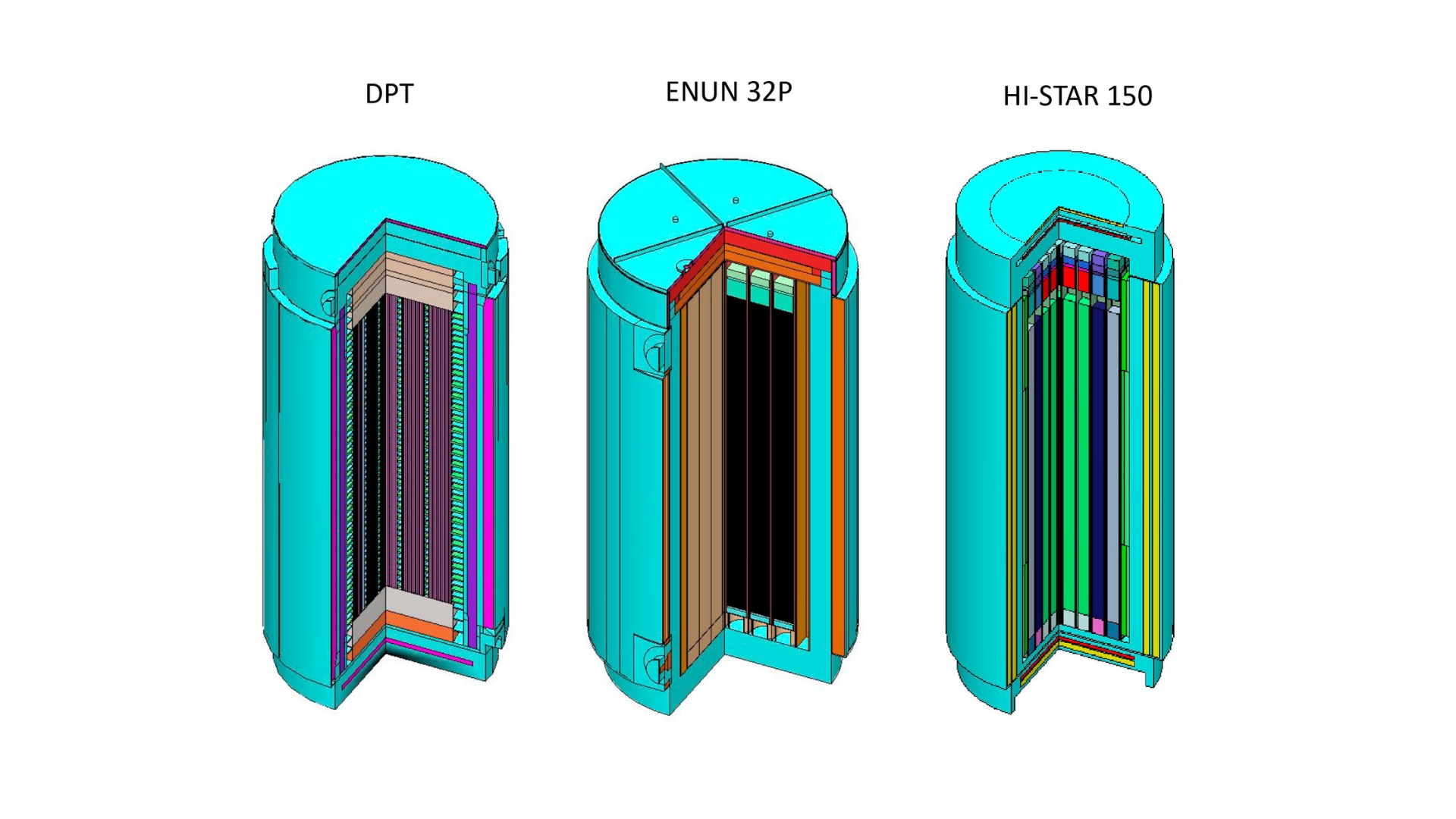

MAVRIC code (part of Scale package) was used to develop detailed models of the casks, slabs, building, and surrounding areas of each ISFSI. Dose rates were calculated using the fluence to effective dose conversion factors from ICPR publication 74, consistent with the Spanish Regulation on health protection against ionizing radiation of 2001 (Royal Decree 783/2001) in force at the time the calculations were made. In 2022, a new Spanish Regulation on health protection against risks arising from exposure to ionizing radiation was published (Royal Decree 1029/2022), which requires that external exposure calculations follow the methodology set out in ICRP publication 116.
Comparison between ICRP 74 and ICRP 116 factors
To determine the effect of the new factors on the radiological calculations of the three aforementioned ISFSIs, the input files of the three ISFSIs were modified to incorporate the conversion factors to effective dose rate from ICRP 116. Dose rates were calculated at different points located outside the ISFSIs, and the results were compared with those obtained in the licensing calculations using the factors from ICRP 74.
The conversion factors from fluence to effective dose from ICRP 74 and ICRP 116 are very similar for photons of all energies. For neutrons, the ICRP 116 factors are only between 50% and 60% of the ICRP 74 values for energies up to 0.05 MeV. For neutrons with energies above 0.05 MeV, the difference between the factors in both publications decreases with increasing energy, and for energies above 0.5 MeV, the factors in both publications are practically the same.

Impact on dose rates in ATIs
The gamma dose rates generated by the three ISFSIs do not change significantly when using the new ICRP 116 factors. The same behavior is observed for all contributions to the total gamma dose rate: fuel gamma source, Co60 source, and secondary gammas.
The effective dose rates for neutrons decrease significantly when using the ICRP 116 factors: about 30% for the ISFSIs with outdoor storage (ATI-20 and ATI-24) and 45% for the ATI with a building (ZY4). The greater reduction in neutron dose rates for ZY4 is due to the less energetic spectrum of the neutrons reaching the calculation, because neutrons must pass through the building’s concrete walls in addition to the cask body and lid, while for ATI-20 and ATI-20 neutrons only need to cross the cask body and lid.
Due to the great contribution of neutrons to the total dose rate, using ICRP 116 factors results in a reduction in total effective dose rates of approximately 20% for ATI-20, 24% for ATI-24, and 28% for ZY4 compared to those obtained using ICRP 74 factors.


