

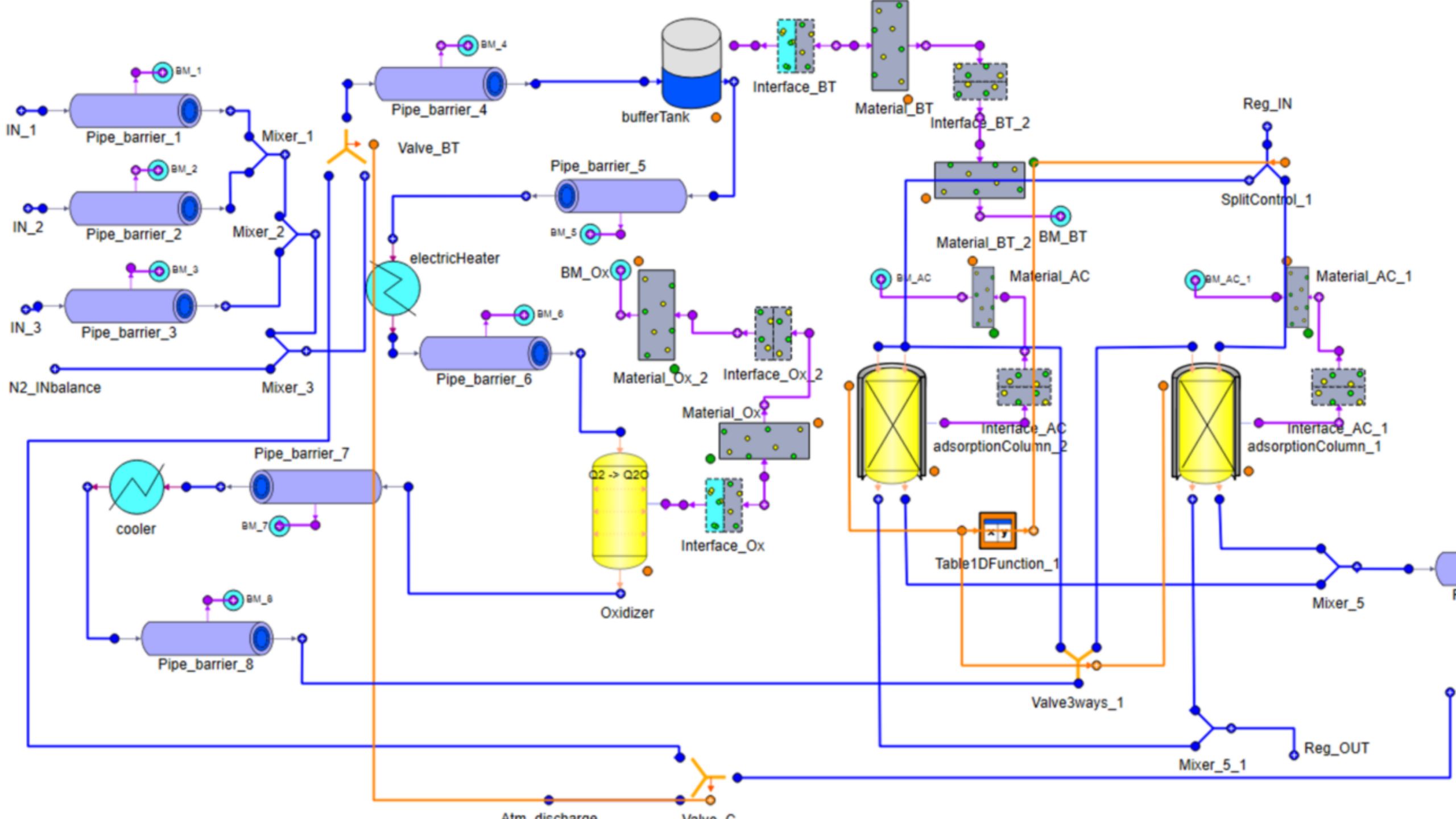

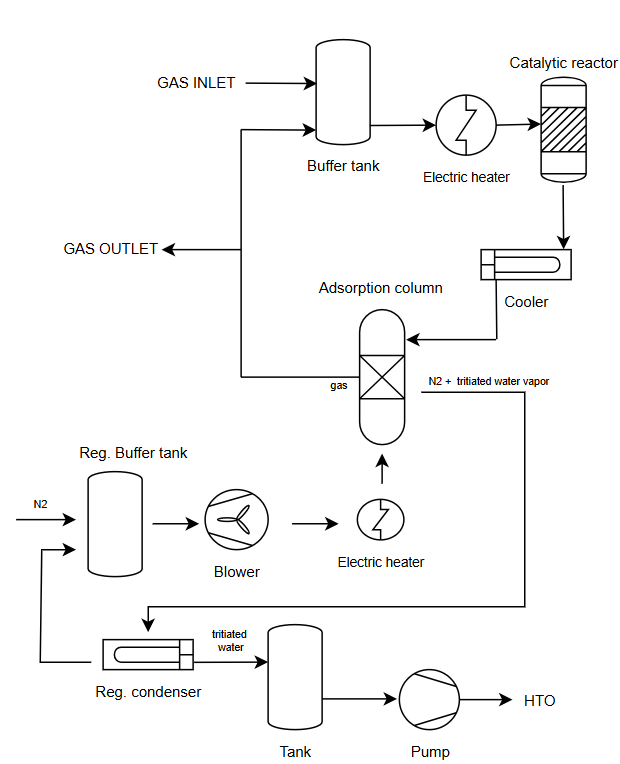
Radiation protection regulations impose strict limits on the release of radioactive substances into the environment. Consequently, facilities that handle tritium incorporate dedicated detritiation systems whose primary function is to minimize emissions while ensuring both environmental protection and worker safety
The challenge of controlling tritium permeation
One of the main challenges associated with tritium is its high diffusivity through a wide range of metals and industrial structures. This phenomenon, known as permeation, can lead to leaks that are difficult to detect and may compromise both the efficiency and safety of processing systems. Therefore, the development of accurate models capable of predicting tritium behavior and quantifying permeation losses is of great importance.
This work focuses on the study of tritium permeation in a radioactive gas treatment system and on the evaluation of potential mitigation strategies. The main objective is to assess the amount of tritium that diffuses through the walls of pipes and industrial equipment and to propose a solution capable of reducing these losses.
To achieve this goal, two different models were developed using EcosimPro, a simulation software widely employed for the design and analysis of steady-state and transient systems. The first model represents the reference system, whereas the second incorporates a 1 µm-thick alumina (Al2O3) internal coating applied to pipes and critical components.
 Alumina as a barrier to reduce tritium losses
Alumina was selected as permeation barrier because hydrogen isotopes exhibit very low solubility in this material. In addition, the coating possesses mechanical properties compatible with those of the metallic materials used in the facility, reducing the occurrence of localized stresses and consequently lowering the risk of cracking and delamination.
Both configurations were analyzed under identical operating conditions in order to evaluate the effect of the coating on tritium permeation and to quantify the achieved reduction using the Permeation Reduction Factor (PRF), defined as the ratio between the permeation of the uncoated system and that of the coated system.
The results obtained show that the incorporation of the alumina coating significantly reduces tritium permeation. The calculated PRF value of 9.46ˣ107 demonstrates the high effectiveness of the alumina barrier as a mitigation method.
Furthermore, the study identified several key factors influencing tritium permeation, particularly the strong effect of temperature. Also, the need to implement recirculation systems in order to comply with established emission limits was identified. Overall, the results confirm that Al2O3 coatings represent a promising solution for improving the safety and efficiency of future nuclear fusion facilities and tritium processing systems.


