

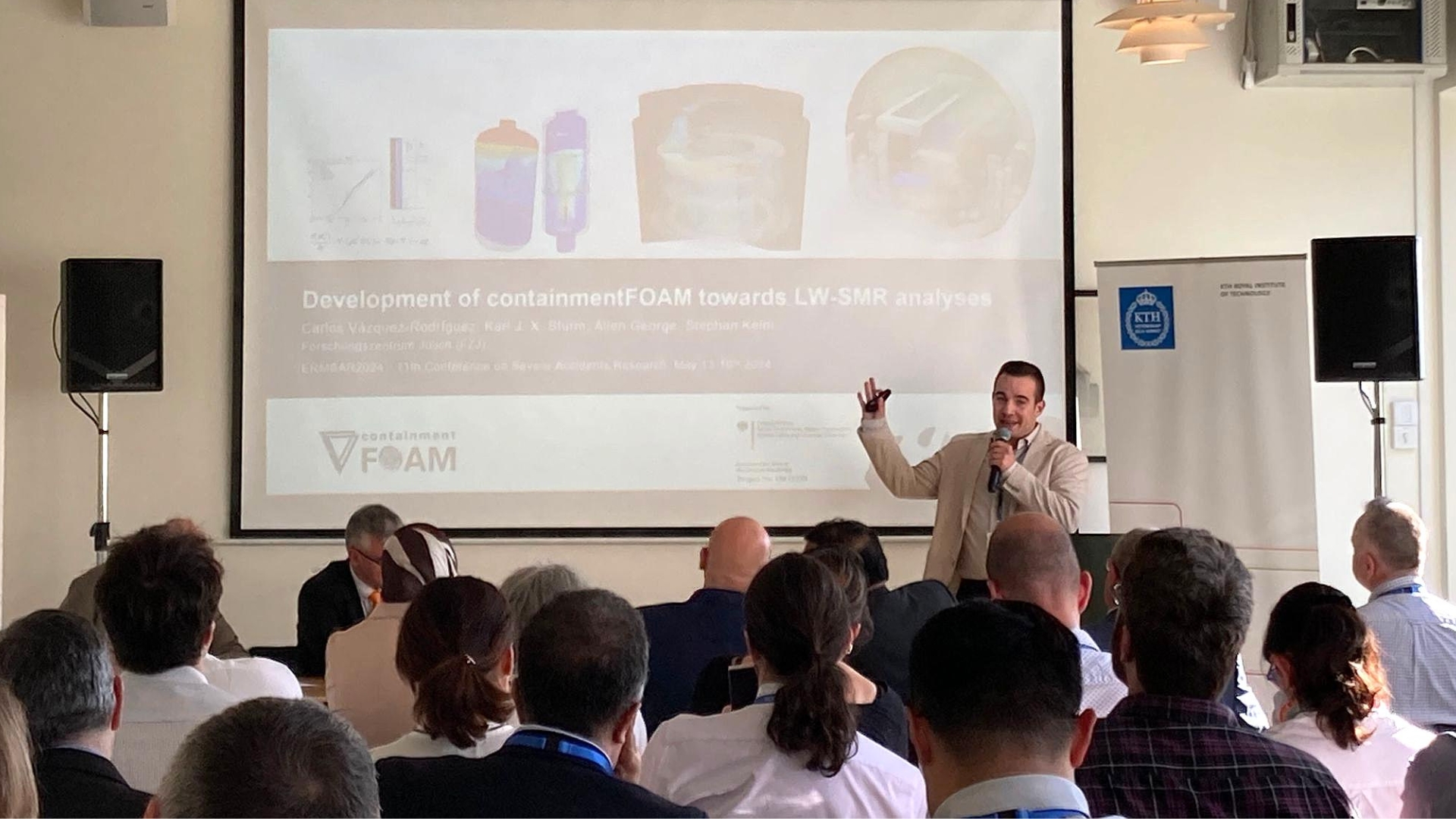
Texts and photographs: Carlos Vázquez Rodríguez
My name is Carlos, although for years everyone has called me Charlie. I completed my bachelor’s degree in Energy Engineering and a master’s degree in Nuclear Science and Technology at UPM (Universidad Politécnica de Madrid), where I also earned my PhD in the field of nuclear safety. After six years of research in the team led by Gonzalo Jiménez at UPM, I moved to Germany at the end of 2022 to begin a postdoctoral position at Forschungszentrum Jülich, one of the largest research centres in Germany.
How many years have you been in your current responsibility?
I’m about to complete two years here. Time flies, but I feel so settled that it seems like I’ve been here much longer.
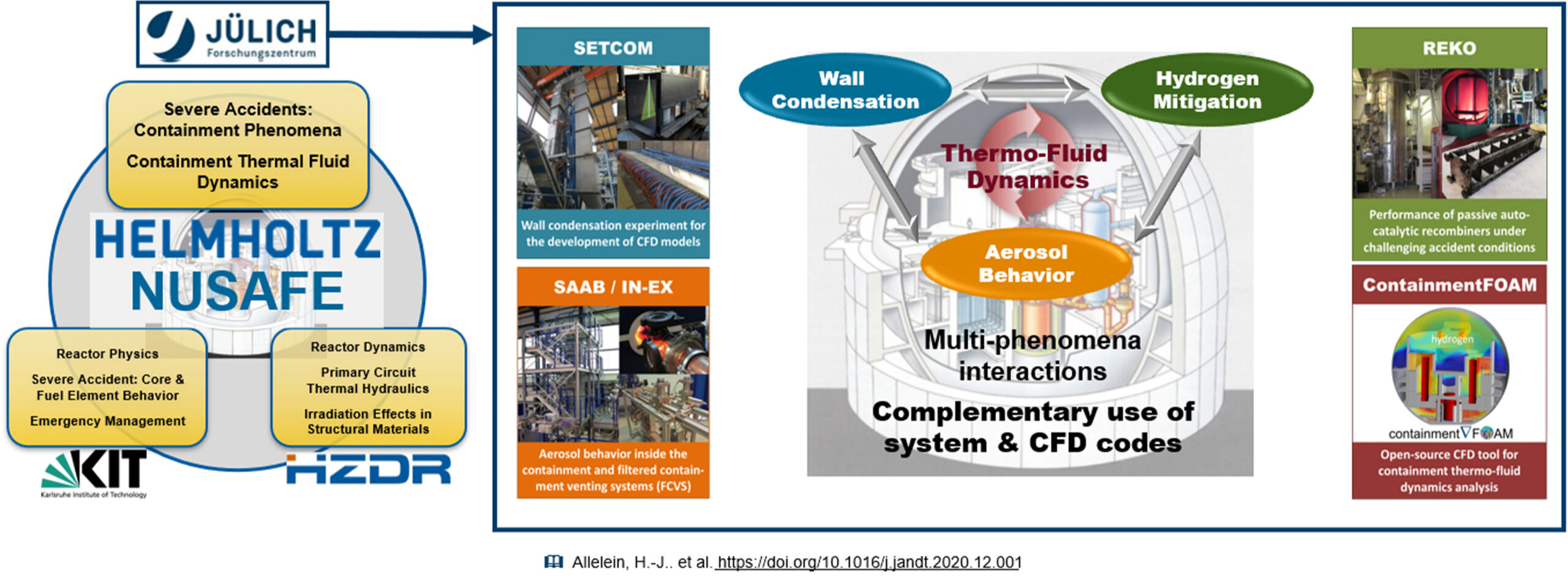
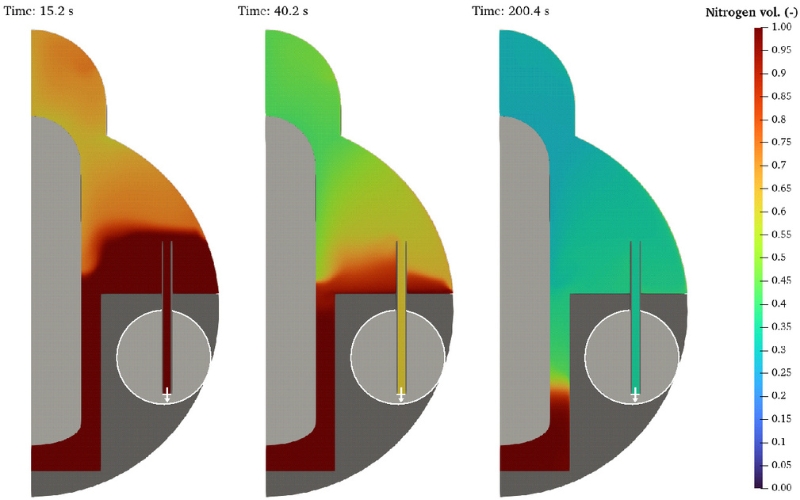
My research group has been working for several years on the development of containmentFOAM, an open-source computational fluid dynamics (CFD) code designed to analyse the thermo-hydraulic behaviour of the containment building. Our team is multidisciplinary, including software engineers, code developers, and people like me, with a larger background in nuclear engineering. My main responsibility is validating the code and building models focused on final plant-scale applications. In theory, you could think of my role as the last link in the chain, consolidating and applying the prior work of the rest of the team.
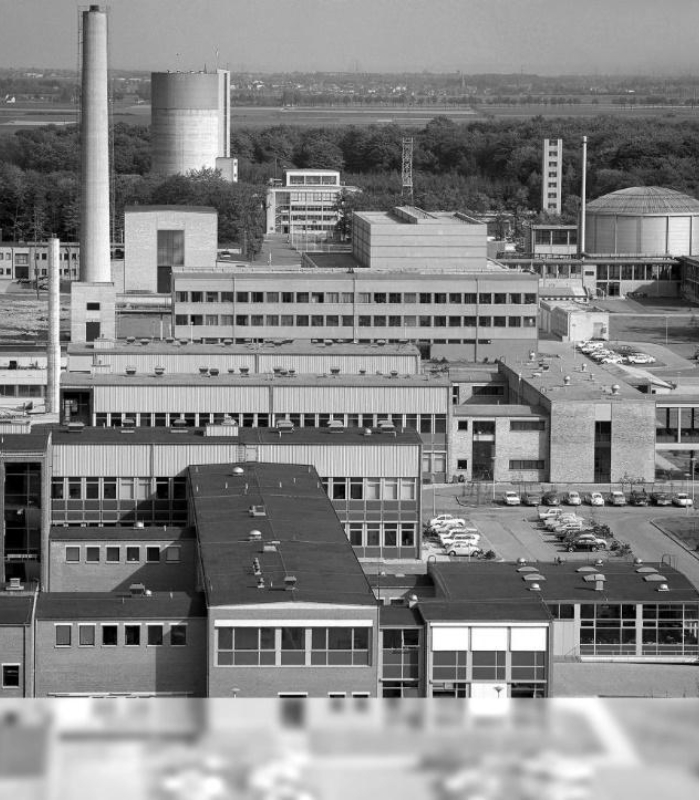
Although the size of the nuclear safety research group decreased after the Fukushima accident to its current size of around 30 members, Jülich has a long history of nuclear technology research. In fact, it was founded in 1956 as a “atomic research center” with the goal of developing and promoting the peaceful uses of nuclear energy. The following image is from the late 1960s, and the tallest building in the background is the AVR Reactor, a pioneer in high-temperature reactor technology and still a precursor to many high-temperature concepts developed today.
In addition to my team’s work on the development of containmentFOAM, our nuclear safety group also conducts experiments in the field of containment safety analysis, focusing on thermohydraulics, hydrogen behavior, and the behavior of fission products. Moreover, Jülich is part of the Helmholtz Association of Research Centers, where KIT (in Karlsruhe) and HZDR (in Dresden) complement and expand the scope of nuclear safety research in Germany.
Which are the main activities of your current position?
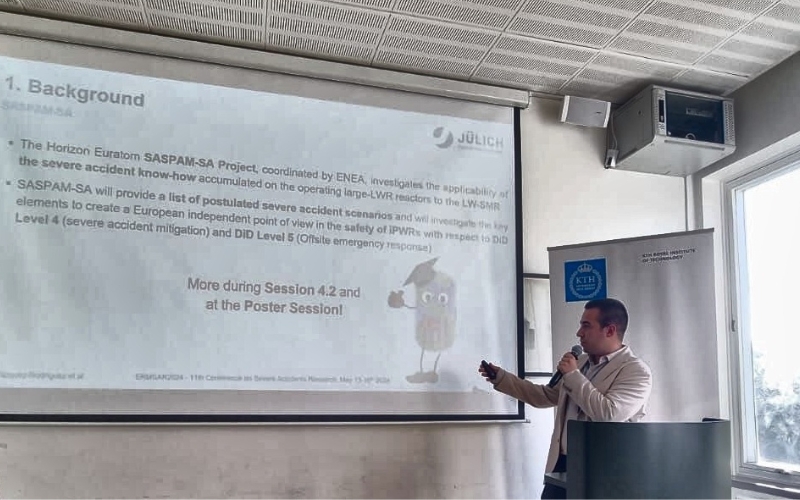
Since I joined the research center, I’ve been assigned the responsibility of leading projects focused on using containmentFOAM for the safety analysis of water-cooled small modular reactors (SMRs). Initially, my work was focused on two very specific SMR projects: one national (INNOPOOL) and one European project funded by Euratom (SASPAM-SA). Over time, in addition to these projects, I was also tasked with providing an overarching view of all SMR-related research activities carried out across Europe.
This has been my main responsibility during my time at Jülich, and also what I’ve enjoyed the most. Earlier, I mentioned that my role theoretically involves applying our code to specific use cases as the “last link in the chain.” However, in practice, everything we’ve learned during this time has required me to adopt a more global perspective of the entire chain, rather than focusing solely on its final stage.
In particular, gaining a better understanding of SMR characteristics has allowed us to identify several areas for improvement. This has been key to adapting our code, originally designed for simulating conventional PWR reactors, to the innovative SMR designs currently being considered in Europe.
Which are the most significant aspects of your work?
Taking all of this into account, my time is divided among three main activities: overseeing all R&D activities related to SMR nuclear safety, identifying and proposing research directions to further improve our code, and—my favourite—sitting in front of my computer to prepare and analyze my simulations.
How did the move influenced your family/personal life?
It changed everything, of course. I was very settled in Madrid after nearly ten years living there, so my daily life was completely transformed. At the time, I was living with my then-partner, now my wife, who also worked in Madrid and couldn’t move with me initially. Luckily, four months later, she was able to transfer internally within her company and continue her career with me in Germany. We consider ourselves very fortunate that these changes happened quickly and smoothly, which definitely made the transition much easier.
For those who, like me, are regular readers of “Nucleares por el Mundo”, it won’t come as a surprise when I say that the first few months after relocating are very tough. Even though moving within the European Union simplifies some things, every country has its own peculiarities, and there’s a lot to sort out in a short time—civil registration, housing, social security, and the many types of insurance required in Germany. All of this was even more challenging in our case because neither of us spoke a word of German at the time.
The language barrier is probably the hardest thing to face. Everyday situations, like going to the doctor or shopping for something for your home, can be a real challenge when you can’t communicate fluently. But as the months go by and the number of “first times” in the new country shrinks, it gets easier. We’ve made a big effort to learn the language as quickly as possible, which I think is essential for integrating into any country.
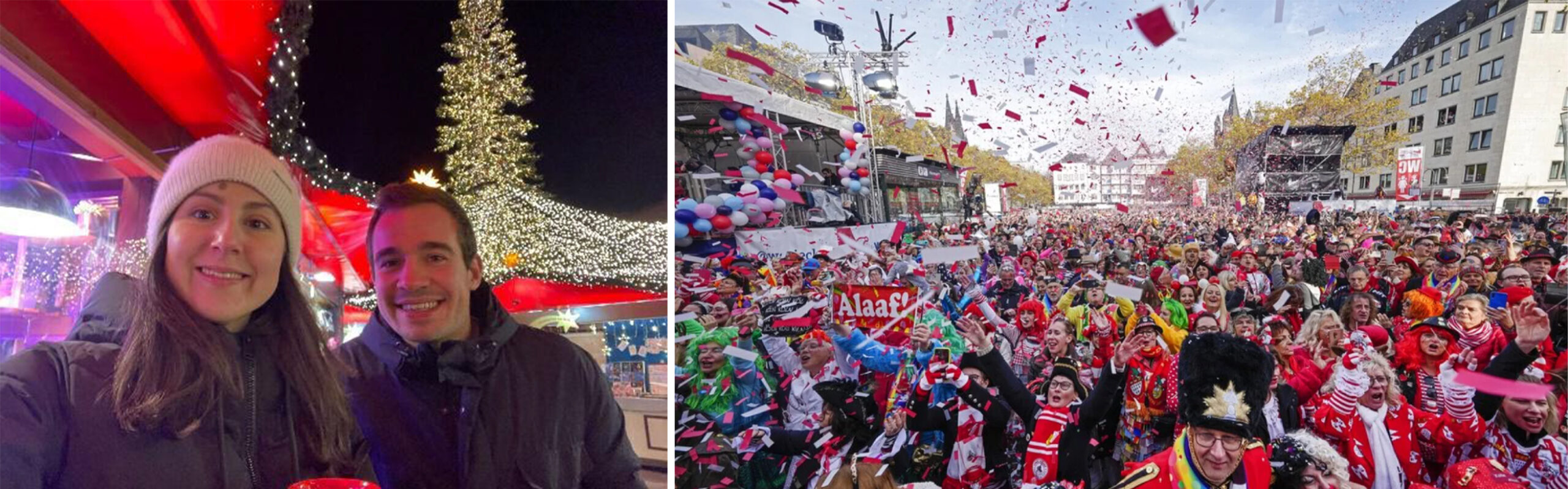
That said, the positives far outweigh the challenges. The only way to truly get to know a new culture is to live with it for an extended period. Many might list Germany’s cold winters as a big drawback, but one of my favourite things about German culture is all the winter events and celebrations that make the season much more enjoyable. In my city, Cologne, the wonderful Christmas markets and the massive Carnival celebrations are real highlights.
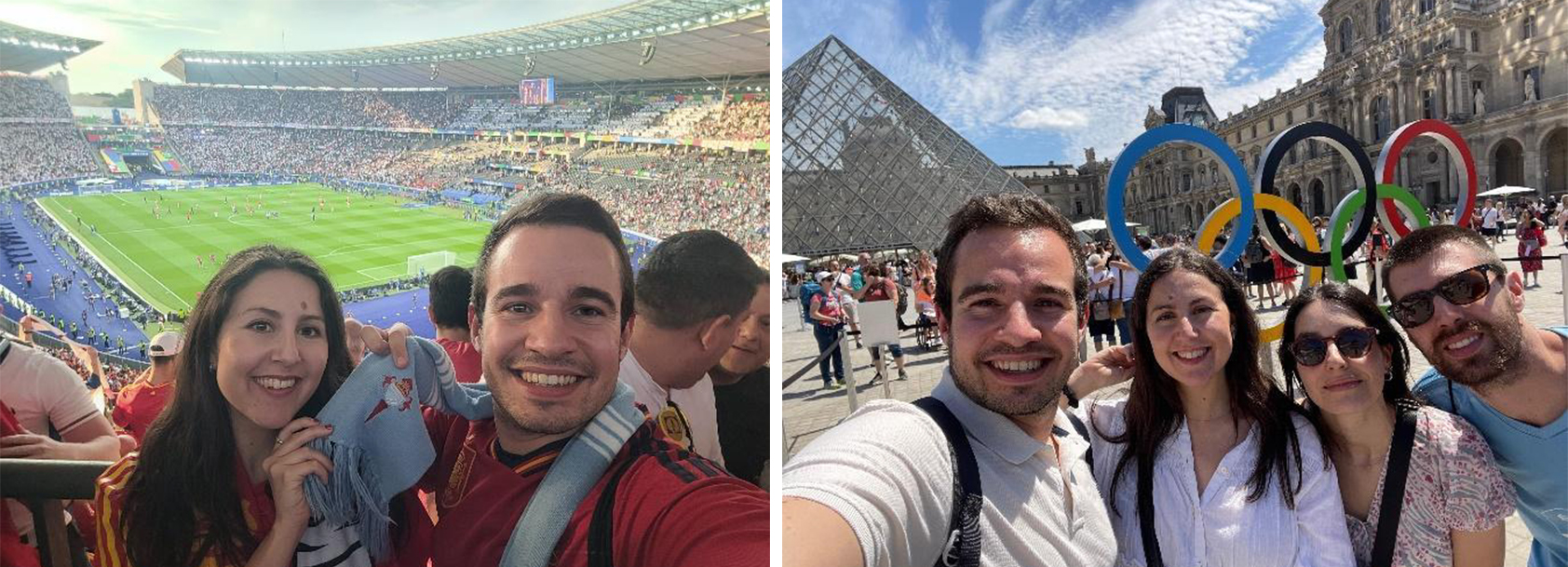
Another great advantage of living in Central Europe is how much easier it is to travel. By train or car, we’ve been able to visit different places in Belgium, the Netherlands, Switzerland, Austria, Italy, and Croatia without needing to take a plane. On top of that, we were lucky to live a few hours away by car or train from the venues of the two major sporting events of summer 2024—the UEFA Euro in Germany and the Paris Olympics. Without a doubt, seeing Spain’s victory over England in the Euro final in Berlin is one of the best experiences of this chapter in our lives.
What do you miss from Spain?
Spain itself—it’s hard to pick just one thing. I miss the food (a lot), our lifestyle, and our climate. Although, being Galician, the weather isn’t a huge issue; it’s more about the lack of daylight in winter. I just can’t get used to it getting dark at 4 PM.
However, what I miss the most, without a doubt, are the people I left behind. It’s not a foreign feeling for me; as Galicians, we carry morriña (homesickness) in our DNA, and I already went through something similar when I left Galicia to spend 10 years of my life in Madrid. So, while there are many “material” things you leave behind when you leave Spain, the hardest part is saying goodbye to the people with whom you’ve shared so many years of your life. Among them are university friends, my research group at UPM, and especially my colleagues from Jóvenes Nucleares, the SNE branch where I was most active, as well as Morriña Celeste, a Celta de Vigo supporters’ group in Madrid that made me feel like home every weekend.
And I’ve saved the hardest part for last—my family. As I mentioned earlier, it’s not a new feeling since I moved out at 19. And while it’s not that different having them three hours away by train or three hours by plane, it gets harder every time I have to say goodbye after visiting them. But well, what can I do? As Rosalía de Castro says in Follas Novas, “Eu son da terra onde a morriña é a nai dos pensamentos” (I am from the land where homesickness is the mother of thoughts).
Do you invite young people to broaden their professional horizons outside?
Absolutely! Working abroad is an incredibly enriching experience. It opens your mind in ways you can’t imagine because you’re exposed to completely different ways of thinking and working. Plus, the change significantly accelerates your learning process—the first few months abroad are remarkable for everything you can absorb, from how day to day goes at work to how projects are structured and managed.
Something that really surprised me about working abroad is how problems are approached differently depending on the culture. Over time, I started noticing certain tendencies in how colleagues from Asia, Europe, or North America tackle challenges, and understanding those cultural differences has been incredibly enriching, both professionally and personally.
That said, it’s important to consider your personal situation before making a decision like this. Moving to another country can be tough at times, and it’s much easier if you have familiar/emotional stability. But if you ever feel that your circumstances allow it, I encourage you go ahead without hesitation. It’s an adventure that’s truly worth it and helps you grow in every way.


