

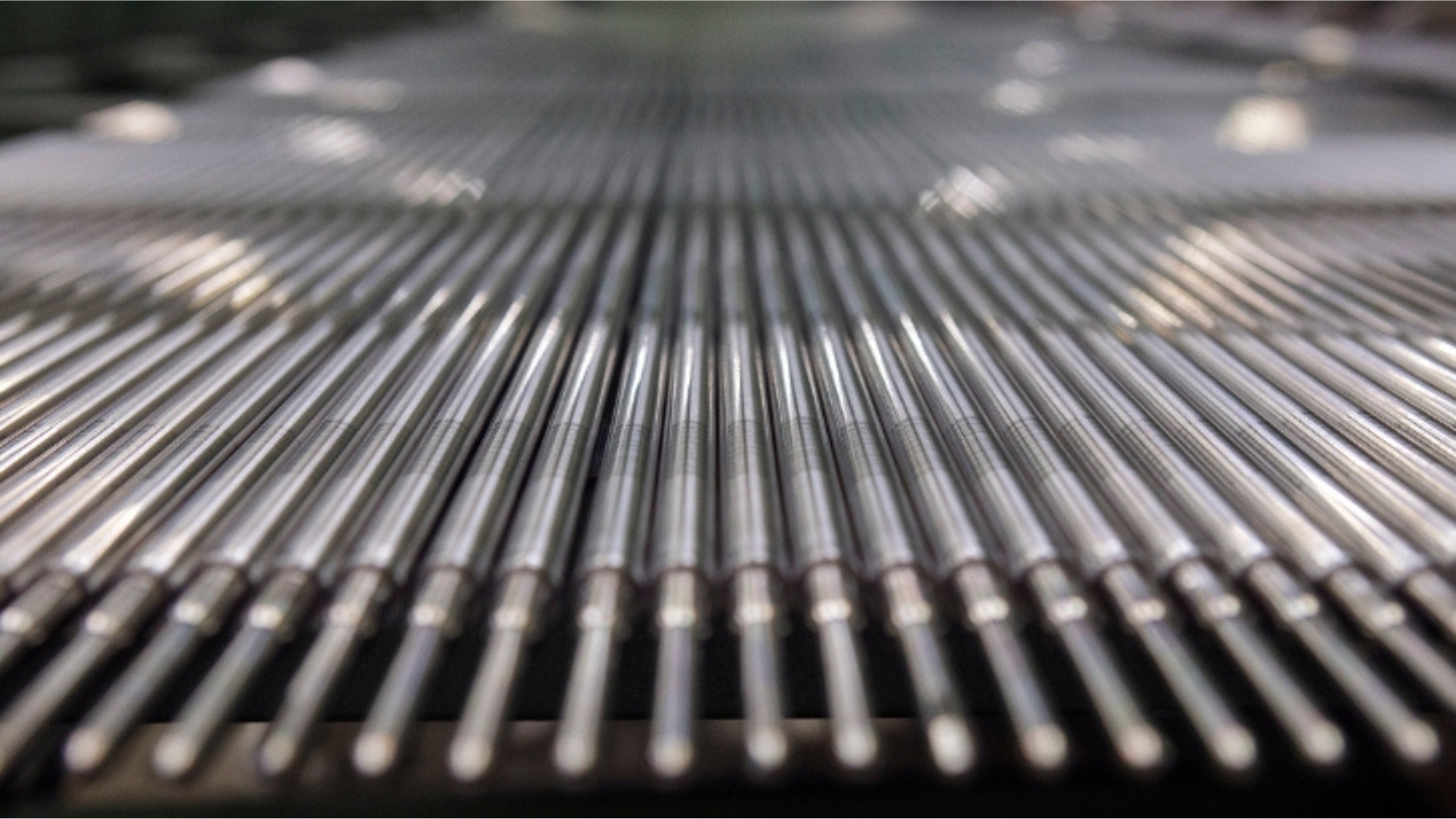

Because they involve a significant design change, chromium coated rods must pass a series of strict safety analyses and plant testing over several operating cycles before being marketed. These tests are performed on prototypes with a limited number of chromium coated rods, which must also undergo a safety assessment. ENUSA is participating with Westinghouse in the verification of thermohydraulic design criteria for prototypes destined for Belgian and French power plants, and the objective of this paper is to present some of the main aspects of this evaluation.
Using tests to check the departure from nucleate boiling specifically performed for this type of rod, it has been verified that the chromium coating does not reduce the critical flow obtained with standard rods. This ensures that the correlations established for these standard rods can also be applied to chromium coated rods. But the analysis must be completed with an evaluation of the effects derived from the small geometric changes due to the thin chromium layer. To this end, the needed changes were made to a typical input of a subchannel code, obtaining results that show a response to the change but which are far from compromising the design limits. However, due to the small magnitude of the simulated changes, it is not evident that the subchannel code is giving the appropriate response, because it is also likely that the obtained result was due to a numerical effect. Therefore, following a maxim of the great physicist John Archibald Wheeler who, in an apparent paradox, urged to never perform a calculation without knowing previously the result, the analysis has been complemented with a specific evaluation of the changes using simplified models developed for this purpose. This evaluation has confirmed that the response of the subchannel code used with the associated core model reproduces in the expected direction and magnitude the effect of the geometric changes due to the chromium layer. The results obtained confirm the safety of the elements with chromium rods that will be used as prototypes for plant testing and also the validity of the design models for their analysis.
The final incorporation of chromium coated rods into the normal operation of nuclear power plants is subject to the successful operation of the prototypes in the plant. However, some test programs have already been initiated, and the inspections carried out confirm the excellent performance of the chromium rods, as they present an appearance practically indistinguishable from that of fresh fuel. Furthermore, the tests on departure from nucleate boiling have also demonstrated the greater resistance to adverse thermal conditions of chromium coated rods, confirming their advantages. This anticipate safety benefits that could even allow for a redefinition of future design criteria on less restrictive bases.


