

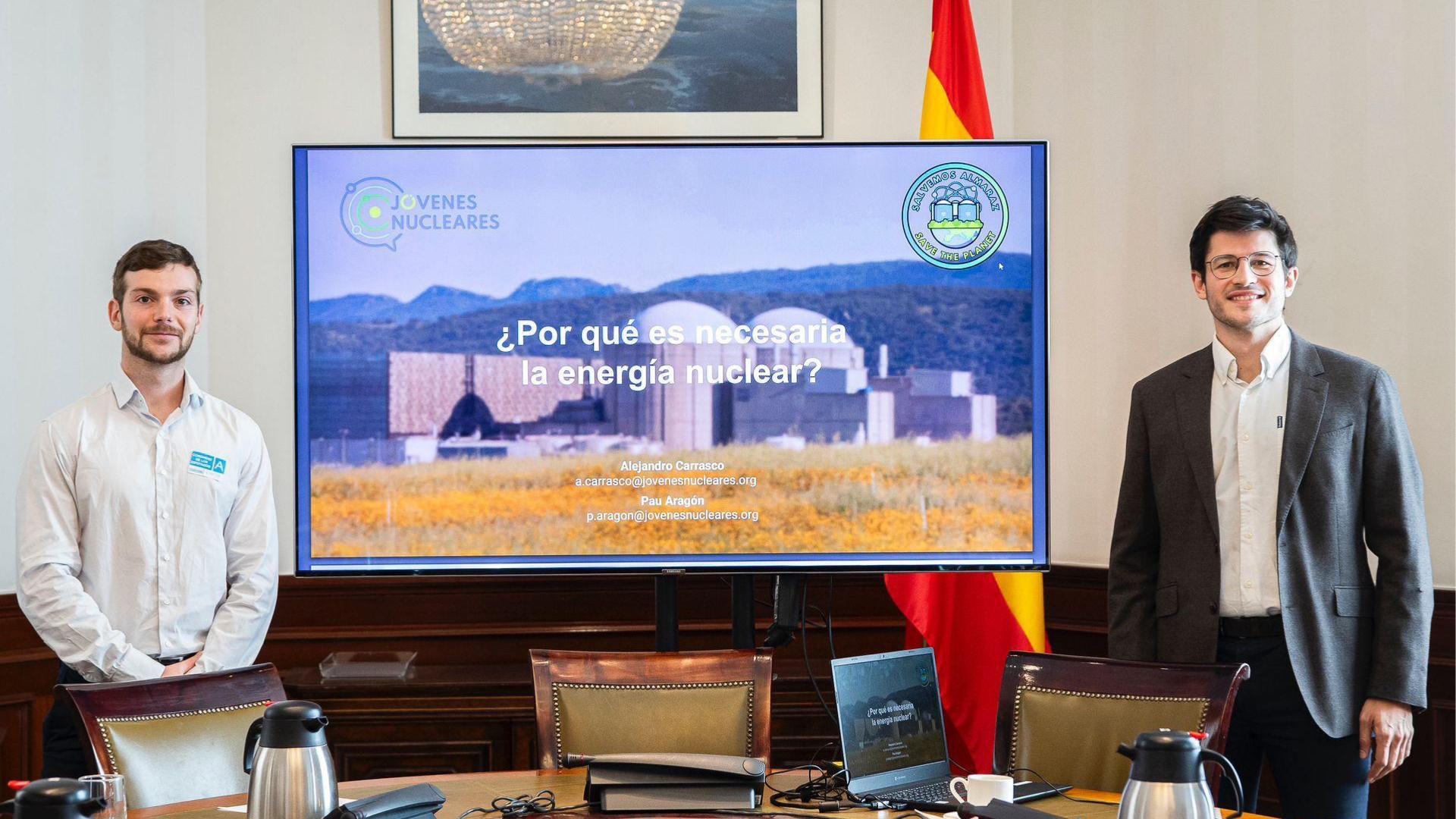

The central focus of JJNN’s presentation was to transmit that young nuclear professionals believe in the continued operation and life extension of the Almaraz Nuclear Power Plant (NPP). This facility has been a cornerstone of clean energy production in Spain, and JJNN put forth a strong case for its Long Term Operation (LTO). The arguments were backed by a detailed flyer for the “Salvemos Almaraz” (Save Almaraz) initiative, which lists several compelling reasons for prolonging the plant’s operational life and supporting scientific references. These include its significant contribution to clean energy, its role in stabilizing the national grid, and its safety record. Moreover, the initiative stressed the economic benefits, particularly in terms of employment and regional economic development.
A critical aspect of JJNN’s presentation was the broader context of global energy challenges, specifically the issue of climate change. The group emphasized the necessity of integrating all low-carbon energy sources, including nuclear alongside renewables, to meet Spain’s CO2 emission reduction targets. In doing so, they pointed to the great number of yearly deaths related to pollution and the recent German experience as a cautionary tale, where the premature closure of nuclear facilities has led to increased fossil fuel dependency, undermining efforts to decrease carbon emissions.
On the topic of safety, JJNN presented compelling statistics to compare the safety records of nuclear energy with other forms of electricity production, such as solar and wind. Citing several sources, they highlighted that nuclear, solar and wind result in fewer fatalities per terawatt-hour produced compared to other energy sources. They also addressed common misperceptions about nuclear safety, comparing it to air travel, which is often perceived as risky despite being statistically one of the safest modes of transportation.
Economic considerations were also a significant part of the discourse, particularly the cost-effectiveness of nuclear energy. JJNN referenced a 2020 IAEA report showing that LTO nuclear power has a lower levelized cost of energy (LCOE) than other energy sources. This point was critical in underscoring the economic viability of life extension of nuclear power as part of a balanced and cost-effective energy mix.
Finally, JJNN brought to the table the unique perspective og their members: the younger generation. Youth has the most significant stake in sustainable energy policies, given that they will live with the consequences of today’s energy decisions. By advocating for nuclear energy, JJNN conveyed a message of responsibility towards future generations, advocating for decisions that ensure both environmental sustainability and economic stability.
In summary, the presentation by Jóvenes Nucleares to the Spanish Congress was a multifaceted discussion that not only made a case for the extended operation of the Almaraz NPP but also positioned nuclear energy as an indispensable part of Spain’s strategy to combat climate change, ensure economic resilience, and secure a sustainable future. Through detailed analysis, statistical evidence, and a forward-looking approach, JJNN effectively communicated the essential role of nuclear power in Spain’s energy landscape.


