


Texts: Matilde Pelegrí y Gema Ortiz | Photographs and video: Grupo SENDA
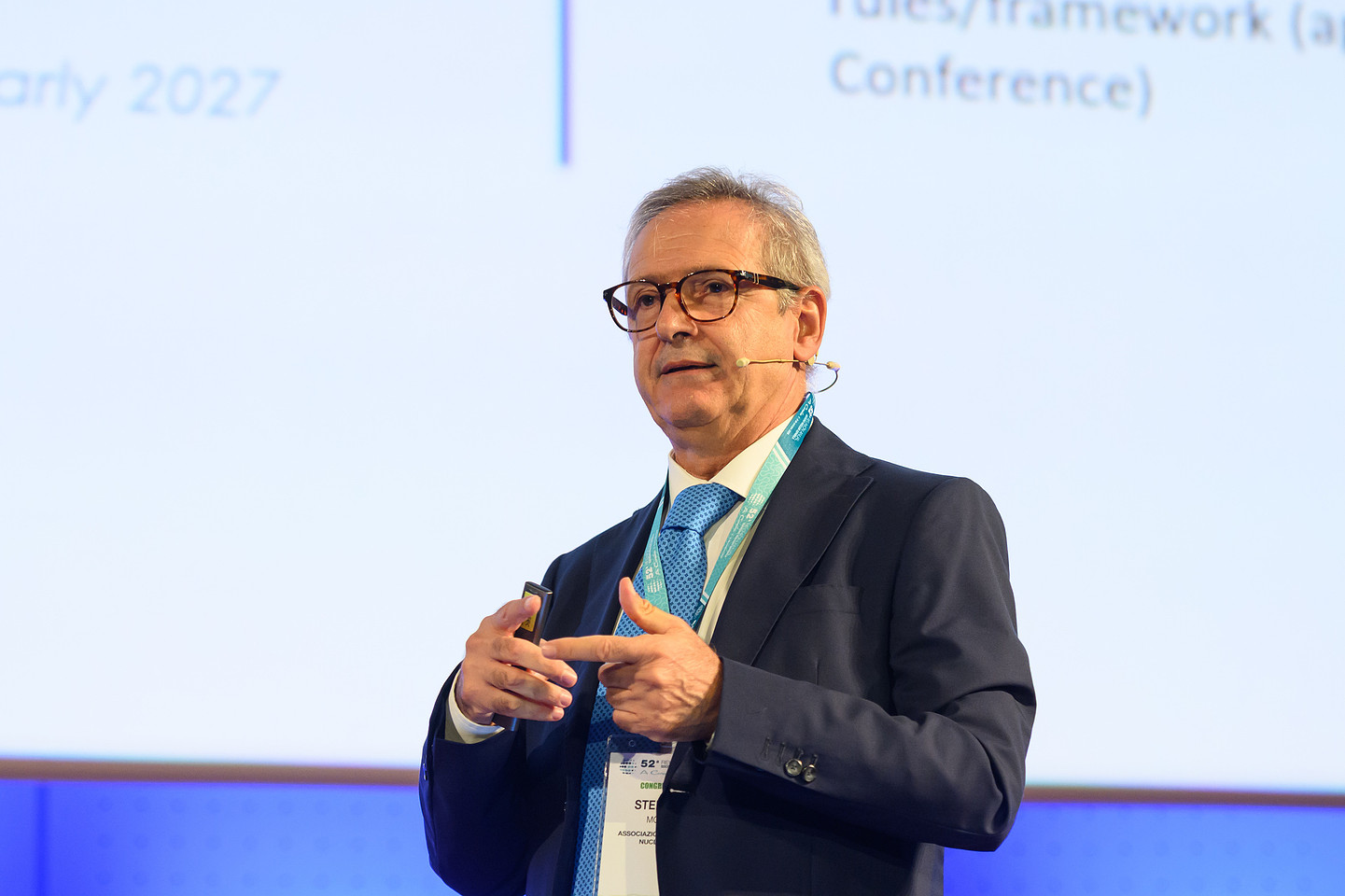
Nearly four decades after abandoning nuclear power generation, Italy is preparing for a return to nuclear energy, with a focus on Small Modular Reactors (SM Rs). The country aims to resume nuclear electricity production around 2035, with nuclear power potentially accounting for between 11% and 22% of electricity demand by 2050. In this interview, Stefano Monti, president of the Italian Nuclear Association (AIN ), discusses legislative progress, industrial and technological challenges, and the need to strengthen energy security and competitiveness. He also calls on the European Union to place nuclear energy and renewables on an equal footing.

Nuclear should be seen not as a competitor to renewables but as a complement to them: its role is to replace gas, not renewables, which will continue to grow in the coming years
ITALY, FORTY YEARS LATER
Italy decided to phase out nuclear energy following the 1987 referendum. The last two operational power plants, Caorso and Trino Vercellese, were shut down in 1990. Throughout all these years, AIN—an organization founded in 1958—has maintained its operations, focusing on research and industrial applications across various sectors. You were appointed president in July 2023.
Who makes up the Association?
The Italian Nuclear Association (Associazione Italiana Nucleare, AIN) is a non-profit scientific and technical association with legal personality representing all the Italian entities (universities, industries and research centres) with expertise in the field of nuclear energy and related technologies. AIN represents the Italian nuclear system within the European Nuclear Society (ENS) and nucleareurope, the European Atomic Forum.
What are its main objectives?
Main objective of AIN is to provide a forum for discussion and a bridge between all those, whether organisations, institutions, companies or individuals, who are interested in developing peaceful applications of nuclear energy and nuclear technologies in line with the Euratom Treaty. In particular, the Association aims to develop and voice opinions on the nuclear sector, with a specific focus on issues related to building nuclear plants and infrastructure in Italy and on nuclear fusion programmes. It also aims to contribute, at both European and global level, to initiatives involving the use of the various forms of nuclear energy and of radioactive substances for industrial, research and medical purposes. The Association also pays constant attention, nationally and internationally, to research and training. Furthermore, it seeks to maintain relations with national, international and supranational bodies in the nuclear sector, and with similar organisations in other countries, in order to make its positions known and to compare them with others, where they differ, in a spirit of constructive dialogue.
A SHIFT IN ITALY ENERGY POLICY
Nearly forty years later, Italy is reconsidering the nuclear option. When did the country begin evaluating a return to nuclear energy?
On 9 May 2023, the Italian Chamber of Deputies approved two motions. Together they gave the Meloni Government a political mandate to reconsider nuclear power as part of the national energy mix. It was the first such opening since the 1987 referendum that ended nuclear generation in Italy. The mandate was later the basis for the National Platform for Sustainable Nuclear (PNNS), set up by Minister of Environment and Energy Security (MASE) in September 2023 and gathering all the relevant Italian stakeholders (industries, utilities, off-takers, universities, research institutes, professionals in the different areas of nuclear energy, etc.). That body led to the Government’s later legislative steps on new nuclear.
What are the most critical factors driving this reconsideration?
Among the EU’s large economies, Italy is the most dependent on imported energy, and its electricity prices are among the highest in Europe. Roughly three quarters of the energy it consumes comes from abroad, much of it natural gas, which also sets the wholesale price of electricity in most hours. At the same time, Italy has committed to ambitious decarbonization targets, both for the power sector and for other end uses of energy such as heating, transport and industry. Meeting these goals is therefore not only a climate obligation but also an opportunity to reduce the country’s exposure to volatile import prices and strengthen its energy security. Thanks largely to generous subsidies over the past two decades, Italy now has a significant share of renewables (hydro, solar, wind and biomass), but on their own they are not enough to meet its energy goals. Addressing the energy trilemma of security, affordability and sustainability therefore requires nuclear power as well. Nuclear should be seen not as a competitor to renewables but as a complement to them: its role is to replace gas, not renewables, which will continue to grow in the coming years.


