

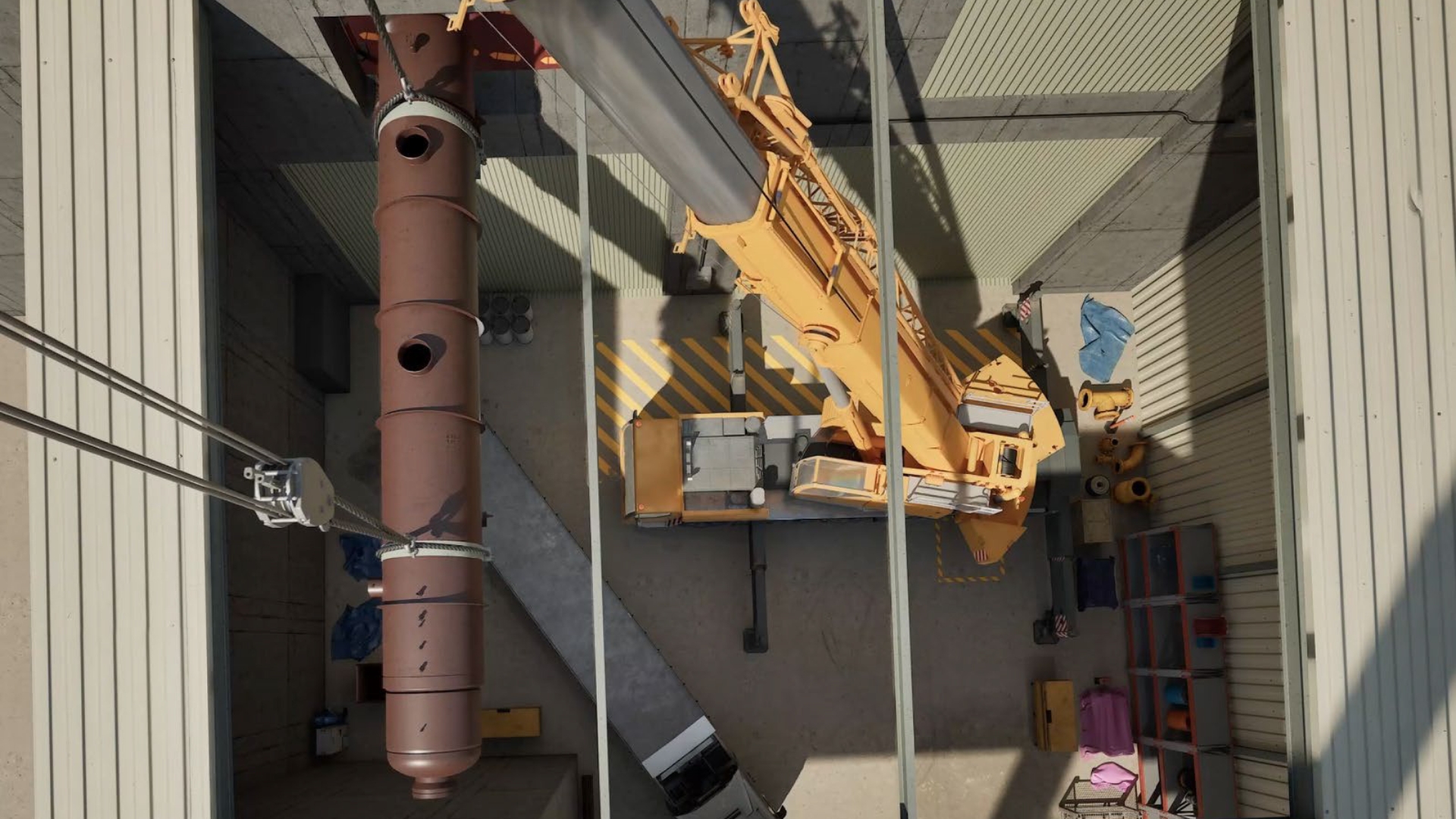

This article presents the technical study developed for the potential future replacement of heaters 2A and 2B at the Cofrentes Nuclear Power Plant. The operation is particularly complex due to its location in areas classified as “regulated occupancy zones,” with restricted access, confined spaces, and logistics routes subject to multiple structural constraints. The adopted strategy made it possible to transform a scenario of high uncertainty into a fully modeled, analyzed, and digitally validated environment.
During refueling outage R24, a high-precision 3D laser scanning campaign was conducted, covering both cubicles T304 and T306 and the interior of the high- and low-pressure condensers. This allowed for the capture of the real geometry of the heater support systems. Based on this data, a detailed BIM model was developed, which served as the foundation for building an operational digital twin. This virtual environment enabled the exhaustive simulation of each phase of the intervention, validating access routes, assessing interferences, and anticipating critical points.
From a technical perspective, this study is part of the progressive application of Industry 4.0 principles to the field of nuclear engineering, integrating high-fidelity digital models and simulation environments as decision-support tools. Its implementation enhances safety conditions, operational efficiency, and the reliability of planned maneuvers, especially in restricted-access areas or those with significant geometric and structural constraints.
The operation includes cutting into the condenser casing, removing internal demountable walls, and dismantling the roof and purlins of the Removal Shop to facilitate final hoisting. Once the equipment is released, synchronized hydraulic jacks are used for controlled lifting, followed by transfer on custom mobile cradles over temporary rails using hydraulic skidding systems. The extraction concludes with a coordinated operation using mobile cranes to transfer the component to the exterior.
The digital environment enabled optimization of travel routes, validation of the full extraction and insertion sequence, minimization of interferences, and reduction of radiological exposure—all without the need for additional physical validations. Moreover, it served as a multidisciplinary coordination tool, improving communication among involved areas and facilitating integrated decision-making.
In conclusion, this study provides a comprehensive technical methodology for carrying out a highly complex component replacement operation within an operational nuclear environment, demonstrating the usefulness and effectiveness of integrated digital technologies in the planning of special operations.
This approach, fully aligned with the principles of predictive engineering, represents a replicable model that positions digitalization as a strategic axis for reliably addressing future interventions in the contemporary nuclear industry.


