

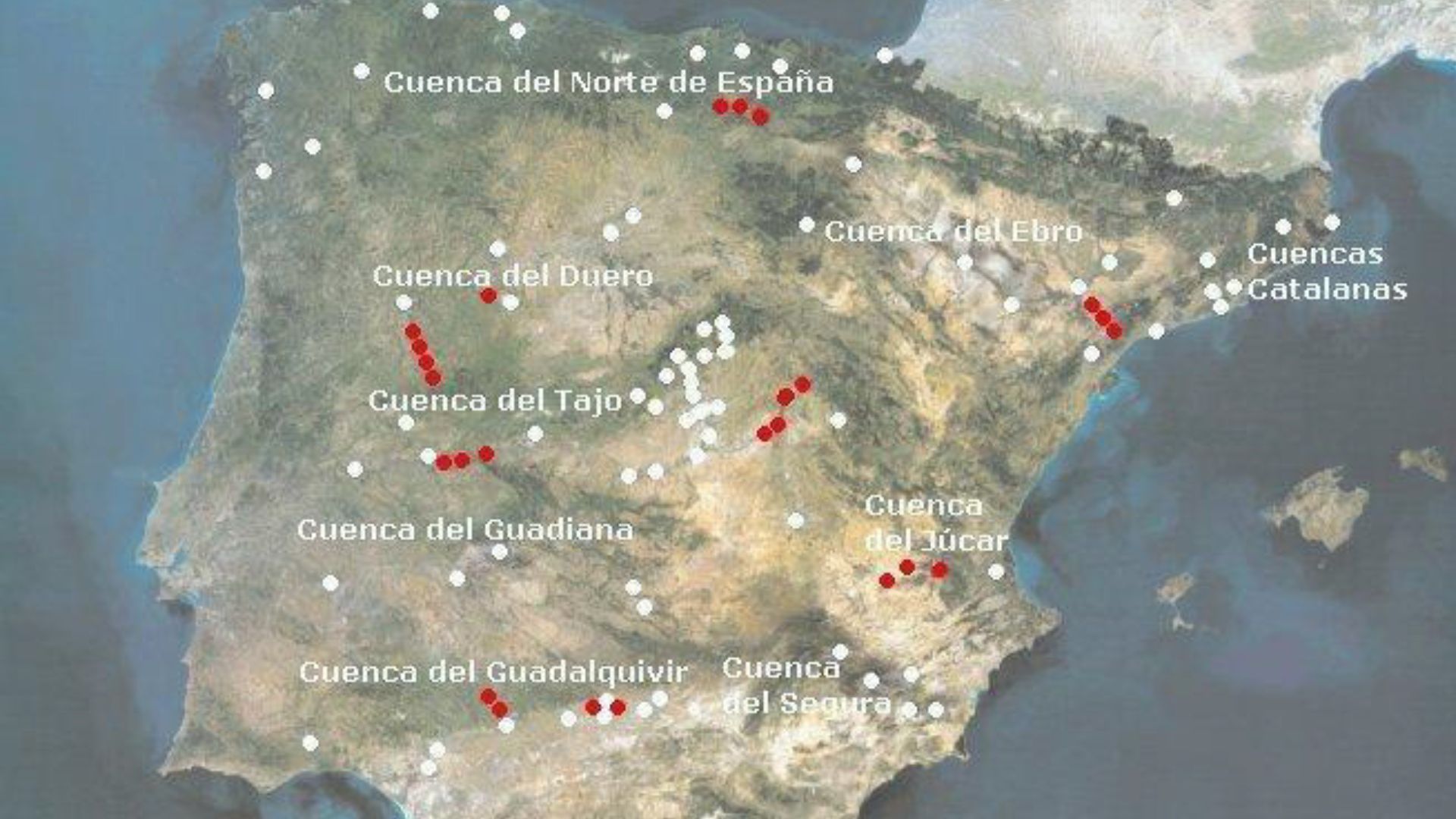

The parameters and radionuclides analyzed in the dense network are gross alpha activity, gross beta activity, residual beta activity, tritium by direct measurement (for river water), tritium by electrolytic enrichment (for seawater) and artificial radionuclides by gamma spectrometry. River water samples are collected from 85 locations on the main tributaries of the Spanish rivers, and seawater is sampled at 15 locations along the Spanish coast.
River waters samples (5 L) are collected manually by local river authorities and sent to the CEDEX laboratory for analysis together with a completed sampling sheet. Seawater samples are collected on the surface on a quarterly basis at 10 miles from the coast, except in seaports, where the samples are collected at the mouth. SASEMAR (Spanish Maritime Safety and Security Society) collects the water samples (10 L) manually and sends them to the CEDEX laboratory for analysis. In both cases, samples are acidified with concentrated nitric acid at a rate of 1 mL per Liter of sample in the laboratory. The counting time for all the parameters is less than 24 hours.
In the sparse network, the radionuclides analyzed are cesium-134 and cesium-137. Both are measured at three Spanish rivers with nuclear facilities (the Ebro, Tajo and Júcar Rivers), while only cesium-137 is measured four seawater locations (the Mediterranea Sea, the Cantabrian Sea and two in the Atlantic Ocean). At these locations, high-sensitivity measurements are performed using gamma spectrometry to accurately represent current radioactivity levels and trends. Sample volumes are 700 liters for river water and 50 liters for seawater. The detection limits and sensitivity of the instruments used in the sparse network are sufficient to quantify the actual levels of radioactivity. Consequently, counting times are approximately one week for seawater and one month for continental waters.
Both the dense and sparse networks are managed by the CSN to fulfill the requirements of Articles 35 and 36 of the Euratom Treaty. Article 35 obliges all Member States to establish the facilities necessary for the continuous monitoring of radioactivity levels in air, water and soil and to ensure compliance with the basic safety standards. Article 36 requires communicating the levels of radioactivity to the European Commission (EC).
Furthermore, article 35 grants the EC a right to verify the operation and efficiency of the facilities and laboratories. The EC’s Joint Research Centre (JRC) provides technical support during these verification visits and in the preparation of reports. The CEDEX Laboratory has been accredited by the Spanish National Accreditation Body (ENAC) under the standard UNE-EN ISO/IEC 17025:2017 since May 2012.


