


Throughout history, every industrial revolution has been driven by an energy or technological leap that transformed both production and society. The transition from coal to oil in 19th-century transport reduced logistics costs by up to 90% and cut travel times from months to days, enabling global trade to expand dramatically. Later, civil aviation in the 20th century brought another disruptive jump, reducing intercontinental travel from days to hours and giving rise to industries dependent on speed and freshness.
Today, maritime transport, responsible for over 80% of world trade by volume, faces a similar crossroads. Despite being the most cost-effective mode of transport (0.02–0.10 USD per kilo versus 2–6 USD for air freight), it remains heavily reliant on heavy fuel oil and liquefied natural gas, producing nearly 1 billion tonnes of CO₂ annually, or about 2.5–3% of global emissions. If shipping were a country, it would rank among the top five emitters worldwide.
In this context, nuclear energy is emerging as a strategic alternative. Once limited to submarines and aircraft carriers, nuclear propulsion is gaining attention as a technology that can simultaneously meet the sector’s three core challenges: cost, autonomy, and emissions. Market projections illustrate this shift: the civil segment is expected to grow from USD 1.14 billion in 2023 to USD 2.23 billion by 2033 (a 6.9% CAGR), while the naval military market will expand from USD 26.5 billion in 2023 to USD 39.7 billion in 2030 (5.9% CAGR). Combined, the global nuclear ship market could approach USD 92.8 billion by 2037.
Adopting nuclear reactors for commercial vessels could virtually eliminate CO₂ emissions, over 90% reductions compared to current fuels. If only 30% of the global fleet switched to nuclear propulsion, emissions could fall by around 300 million tonnes per year, equivalent to Spain’s total output. The recent regulatory reforms by the International Maritime Organization (IMO) and the International Atomic Energy Agency (IAEA) are key enablers. The IMO’s 2025 decision to update the 1981 Nuclear Ship Safety Code paves the way for new small modular reactors (SMRs) and advanced designs such as molten-salt or lead-cooled reactors. Meanwhile, the IAEA’s ATLAS program will establish an international licensing and oversight framework, providing legal clarity and consistent safety standards for civilian nuclear vessels.
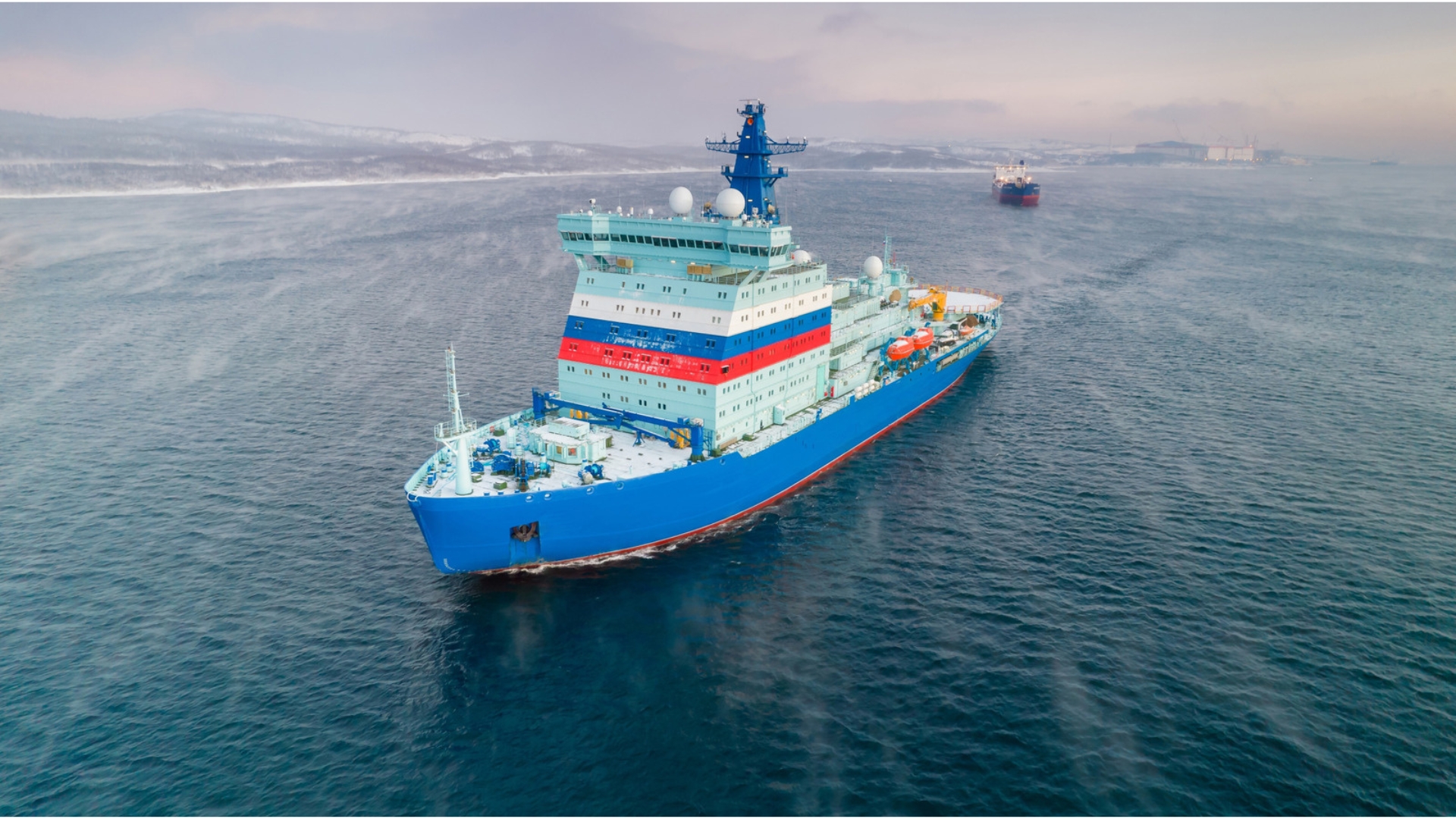
Several countries are already leading practical initiatives. Russia operates the world’s largest civilian nuclear fleet, including the RITM-200-powered Project 22220 icebreakers. South Korea’s HD Hyundai has unveiled a 15,000 TEU container ship concept powered by SMRs. Norway’s NuProShip I consortium is developing fourth-generation TRISO-fuel, helium- and lead-cooled reactor concepts, while China is pursuing a 24,000 TEU thorium-based molten-salt design. Private players such as Maersk, Lloyd’s Register, and Core Power are also evaluating commercial deployment scenarios. These examples confirm that nuclear propulsion is transitioning from theory to industrial reality.
With regulatory modernization, mature technology, and institutional financing, including a 2025 cooperation agreement between the World Bank and the IAEA, nuclear propulsion is poised to enter the commercial stage by the early 2030s. This shift promises to revolutionize global logistics by cutting emissions, increasing autonomy, and lowering long-term costs.
The conclusion is that convergence of innovation, policy, and investment is positioning nuclear maritime propulsion as a cornerstone of 21st-century decarbonization and energy independence. What once seemed futuristic is now within reach: nuclear-powered shipping may soon define the next great leap in industrial and environmental transformation.


