


Specific challenges include:
Minimization of waste volume: decommissioning generates significant volumes of low-level (LLW) and very low-level waste (VLLW). While Spain estimations indicate that 93.700 tons of VLLW and 53.100 tons of LILW will still be produced, mainly from NPPs dismantling (7°PGRR), France anticipates in the long term 2.1–2.3 million m³ of VLLW, with 500,000 tons of metals requiring treatment for minimization or reuse starting in 2031.
Radiological protection: Although fuel removal eliminates almost all on-site radioactivity, activated or contaminated components pose risks to workers, requiring custom tools.
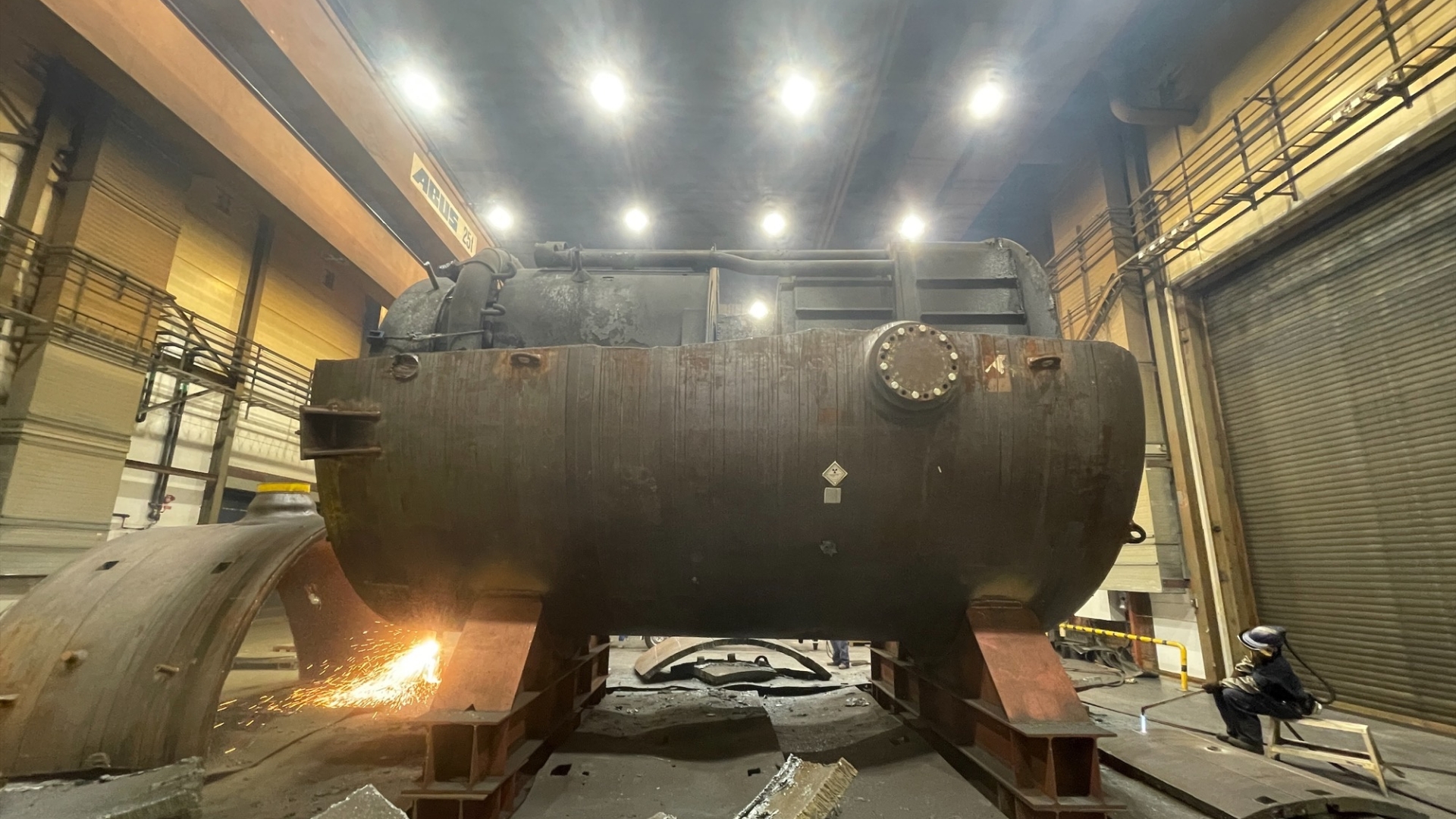
Large components can be managed in two main ways once the general dismantling strategy is defined (deferred or immediate): these are In Situ Dismantling strategies or “Rip & Ship”.
- In Situ Dismantling:
Involves cutting and segmenting components directly at the nuclear power plant site.
Its main advantage is dismantling without massive transportation.
Its main disadvantages are: it requires dedicated cutting areas, purchase of specialized equipment and skilled operators for decontamination, cutting, and waste conditioning operations. On the other hand, it requires the implementation of strategies for waste declassification and release, with adapted logistics.
- “Rip & Ship” or External Dismantling:
Consists of transporting complete components to a temporary storage facility or an external treatment plant.
Its advantages are rapid implementation, significantly reduced on-site radiation exposure, and optimized waste volume reduction and recycling, as specialized facilities have processes such as decontaminating melting that allow for a higher recycling rate than mechanical or chemical decontamination procedures.
Its main disadvantage is the complex logistics of transporting heavy parts, potential public opposition, and the availability of specialized external facilities.
International experience shows that both strategies are viable.
The advantages and disadvantages are highly dependent on the type of component to be managed, as well as its physical and radiological characteristics.
The choice depends on regulations, site priorities, storage availability, waste management, and costs.
Temporary storage in suitable external facilities can be economically and radiologically favorable.
In France, EDF (Électricité de France) has chosen to centralize treatment outside the plant at external facilities operated by its subsidiary Cyclife, in order to mitigate risks, reduce costs, and minimize waste—resulting in a more economically and radiologically favorable solution for EDF. Additionally, EDF has a large number of replaced large components (~150 SGs) that need to be dismantled, which allows the economic investment to be easily amortized thanks to economies of scale, process standardization, and optimization of logistics and technical resources.
This article presents a focus on the Technocentre, a pioneering EDF project aimed at valorizing and recycling very low-activity metals from nuclear dismantling in the conventional industry.
The future facility, covering 15 hectares and 30,000 m² of plant space, will process 25,000 tons of steel per year, including 12–18 SGs.
It will use an electric arc furnace to melt the steel, producing ingots that meet radiological criteria to be declassified and reused in conventional industry.
- Advantages:
Recycling will release up to 80% of the material from a SG and valorize 500,000 tons of steel, saving 450,000 m³ of storage.
It will reduce energy consumption by 40% and the carbon footprint by 60% compared to virgin steel production. - Timeline:
Scheduled for 2031, it will create 180–200 direct jobs.
The investment is €450 million.
It will have the capacity to process components from international sources.


