

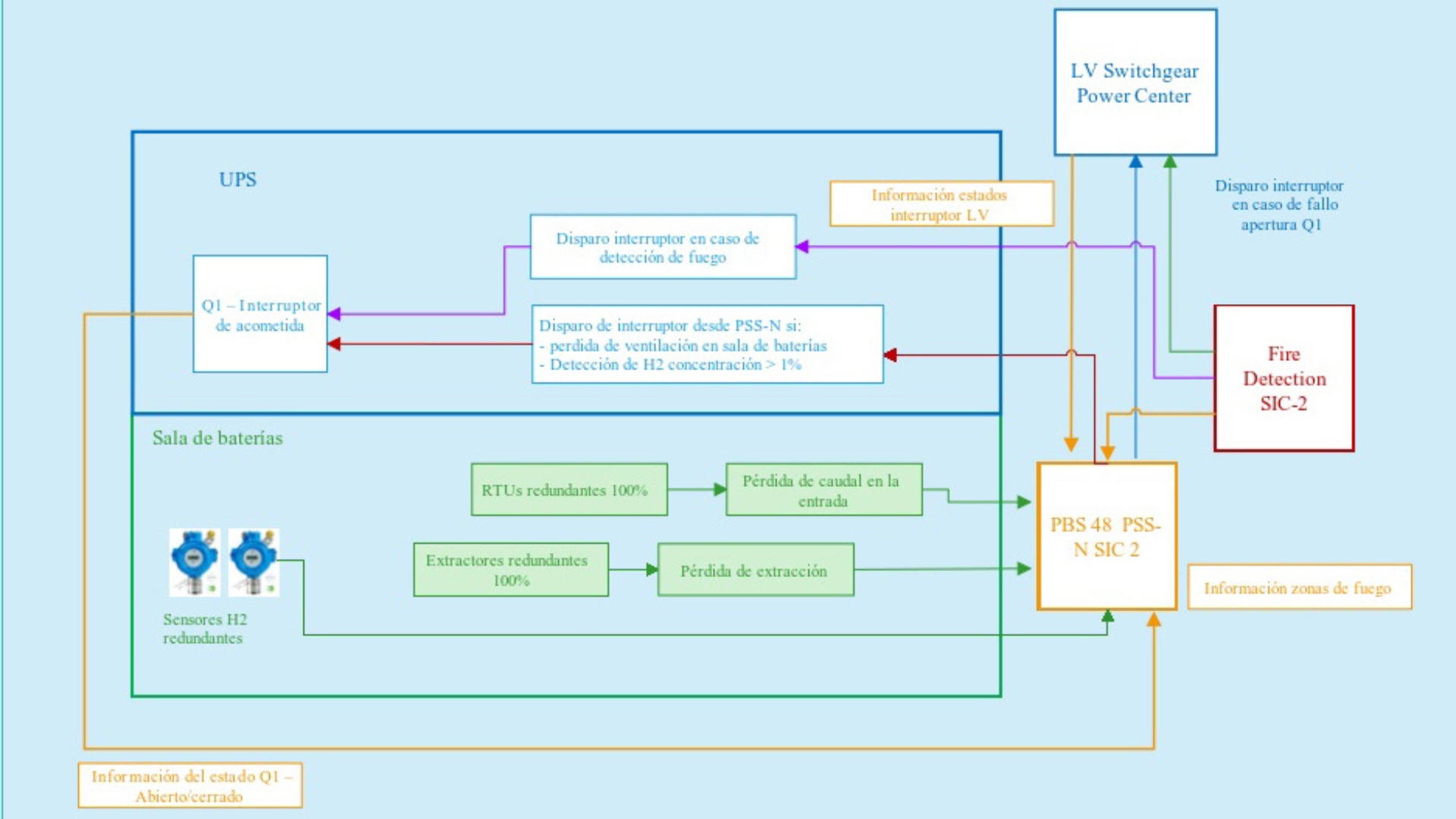

Hydrogen is a highly flammable gas that can form explosive atmospheres when its concentration in air exceeds 4% by volume. To prevent reaching this threshold, installations must ensure concentrations remain well below this level, typically enforcing preventive action limits around 1%. In this context, a dedicated safety function has been developed to prevent hydrogen accumulation in the battery rooms of ITER buildings 44 and 45.
The adopted strategy is based on a comprehensive approach combining ventilation, early detection, and automatic response. The rooms are equipped with redundant HVAC systems to ensure continuous air renewal. Additionally, redundant hydrogen detectors are installed, configured with safety logic to reliably detect concentration increases.
The system defines different response levels. At 0.5% concentration, an alarm is triggered to alert operators. At 1%, the situation is considered critical, and battery charging is automatically stopped by tripping breakers in both the UPS and upstream low-voltage distribution panels. Redundant actuation paths ensure compliance with the single failure criterion.
Additional scenarios such as ventilation failure and fire detection are also addressed. In the event of prolonged ventilation loss, a calculated delay based on hydrogen accumulation is applied before disconnecting battery charging. In case of fire detection, immediate action is taken to minimize risks.
From a design perspective, key nuclear safety principles have been applied, including defense in depth, redundancy, and failsafe design. The architecture relies on hardwired systems and certified safety controllers, avoiding reliance on communication networks that could compromise reliability.
Overall, the implemented solution not only complies with international standards and ITER-specific requirements but also provides a robust and replicable framework for managing hydrogen risks in critical industrial facilities


