

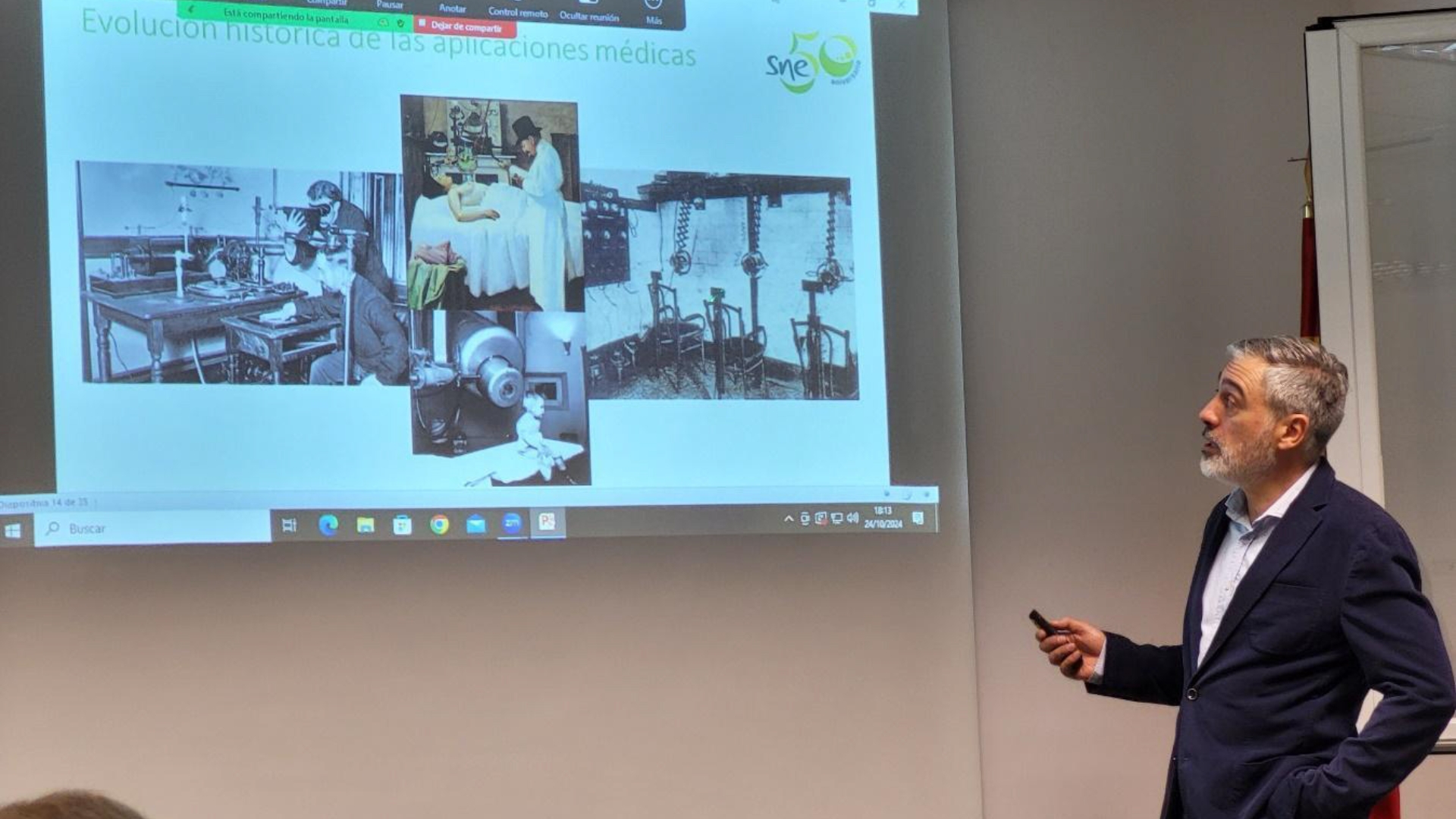
On October 24, the last edition of the so-called ‘Nuclear Thursdays’ (Jueves Nucleares) took place prior to the event of the 50th Anniversary of the Spanish Nuclear Society. On this occasion, the Programmes Commission of the Spanish Nuclear Society, in collaboration with Jóvenes Nucleares and the working group of the 50th anniversary of the SNE, organised a talk to show a journey through the history of the last 50 years of ionizing radiation applications in nuclear medicine. Also, the focus was put on how the evolution of nuclear technology has had an impact on the evolution of this branch of medicine to the present day. The talk, presented by Julio Blanco, was entitled “50 years of Nuclear Medicine: Applications of ionizing radiation in medicine” and was given by Carlos Prieto Martín, Head of the Radiophysics and Radiological Protection Service of the Hospital Universitario de La Princesa.
The speaker, who was attending the SNE as such for the first time, was also a radiophysicist at the Medical Physics Service of the San Carlos Clinical Hospital and head of the Radiotherapy area, as well as the author of more than 100 publications and communications in the field of medical radiophysics. Carlos also has experience as a consultant in various organizations, such as the Department of Health of the Community of Madrid, the Ministry of Health and Consumer Affairs, the CSN or the IAEA, having also participated in more than 10 missions as an IAEA expert in the field of radiotherapy. Not only that, but he has participated in research projects such as MARLIN, ACCIRAD, MARR, MARRTA and is a member of different working groups of the SEPR and the SEFM in different areas, but especially in aspects of safety in radiotherapy. The speaker’s extensive experience could be corroborated by the more than 20 attendees of the talk, both in person and online, and was tested in a Q&A of almost an hour.
Carlos accompanied us through the uses and advances, in the last 50 years of radiation in medicine. Thus, he began by reminding us of what we mean by ionizing radiation and how much we receive due to nuclear medicine. For example, he stressed that CT scans account for 24% of the exposure we receive, on average and per year, due to this type of test. On the other hand, Carlos provided very curious data about radioactivity, such as that between two heartbeats between 8,000 and 10,000 atomic nuclei disintegrate in our body, or that due to the food we consume, about 15 million potassium-40 nuclei and about 7,000 of natural uranium disintegrate in our stomach and intestines.
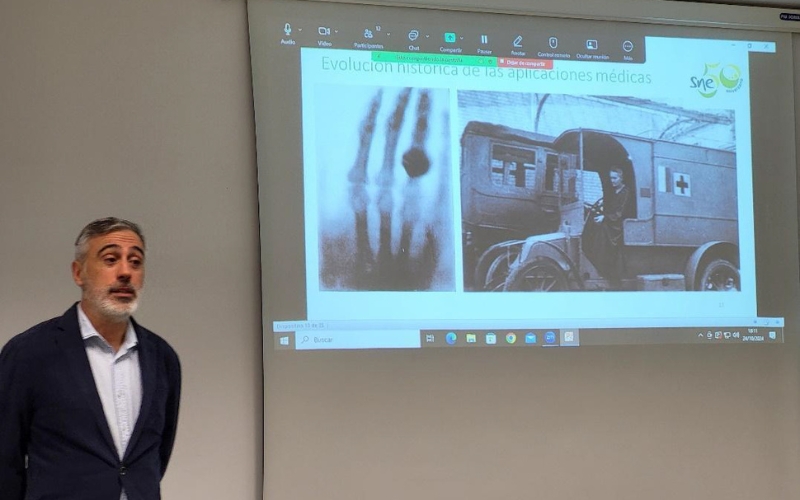
The journey through the exciting history of radiation in medicine began on November 8, 1895, with the discovery, by mere chance, of X-rays by Wilhelm Röntgen. A year later, Henri Becquerel discovered radioactivity and later the Curies discovered two new radioactive elements more radioactive than uranium: polonium and radium. All of them, Nobel Prize laureates, saw in their days how, at first, radiation gained a good reputation, which translated into numerous inventions and day-to-day gadgets that made use of different radioisotopes. Taking advantage of the applications with the greatest potential, not much later the first X-ray diagnoses would appear and fields such as Diagnostic and Therapeutic Nuclear Medicine, Interventional Radiology, External Radiotherapy, or Brachytherapy would be born.
Carlos pointed out that the medical use of radiation is by far the largest use of radiation (more than 10 million daily medical exposures in the world) and the one with the highest exposure, more than 95% of exposures due to artificial sources are medical exposures. In addition, he stated that medical applications of radiation are carried out in all countries of the world, “which cannot be said of any other use of radiation, being on the other hand the benefits much greater than the possible risks.”
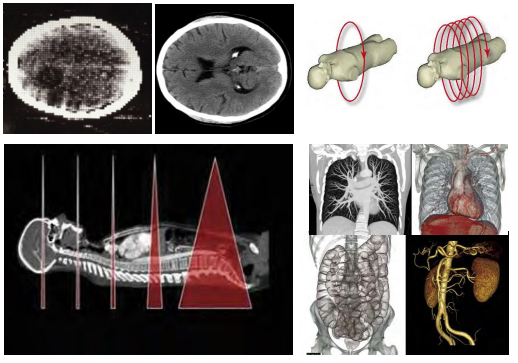
Continuing with the history of radiation in medicine, Carlos took us back 50 years to tell us about the birth of computed tomography, better known as CT. It was the EMI record company that created the Central Research Laboratory where, in 1971, the first image of a skull was processed from the measurement, for 5 minutes and with a state-of-the-art detector, of the head of a patient at Atkison Moreley’s hospital. With this, Allan M. Cormack and Godfrey N. Hounsfield won the Nobel Prize in Medicine in 1979. Today, CT scans are not only a common test, but faster and even with three-dimensional visualization capability. On the other hand, another technique such as SPECT, was born in the 50s together with the use of gamma-ray emitting radiopharmaceuticals. In 1962, the first gamma camera was marketed and in 1977 SPECTs began to be used with rotary gamma cameras. Today, the technique has evolved into the well-known positron emission tomography (PET-CT).
Carlos told us that in the past, minimally invasive, X-ray-guided interventional radiology procedures were performed to diagnose or treat vascular damage. Nowadays, these techniques are used in as diverse fields as Interventional Cardiology, Interventional Radiology, Neurosurgery, or in the areas of Digestive, Urology, Vascular Surgery, and Pain Unit. Angioplasties, angiographies, embolizations, biopsies, radiofrequency ablations, vertebroplasties or radioembolizations are some of the terms with which radiophysicists currently coexist. On the other hand, 50 years ago, therapeutic nuclear medicine also took its first steps, with Nuclear Medicine being recognized in 1971 as a medical specialty in the USA. Currently, professionals talk about theragnosis (diagnosis plus therapy) with increasingly specific radiopharmaceuticals that allow progress in quasi-personalized medical treatments. As examples, the use of gallium-68 in various diagnoses and lutetium-177 for the treatment of prostate or neuroendocrine tumors.
Following this coming and going of flashbacks and flashforwards, Carlos told us about the first cobalt-60 ‘bombs’ that arrived in Spain, used in External Radiotherapy for the treatment of some tumors and benign diseases, and how today, these devices are obsolete compared to cutting-edge techniques such as proton therapy. Another example, in the field of Brachytherapy, is how half a century ago sealed radioactive sources (radium-226 or iridium-192) were used to treat tumors, to give way more recently to delayed-radioactive-loading techniques.
Going through some more applications and anecdotes, Carlos gave us a preview of what is to come. Applications of Artificial Intelligence, Big Data, or 3D printing will find their usefulness in precision, personalized and regenerative medicine, as well as in the new field of Telemedicine. However, access to these techniques, as well as to the present ones, is not the same throughout the world, with countries with serious difficulties in accessing these technologies.
Finally, Carlos told us that, in Spain, doctors and radiophysicists strive to apply current and future techniques with the greatest professionalism, prescribing only the necessary procedures to avoid costs and waits in hospitals, as well as anxiety and excessive doses in patients. The latter, in addition, perceive radiation as something dangerous (Carlos shared with us that a typical phrase during procedures is “stay still, we’re going to shoot you”), so language and terminology are key to informing about ionizing radiation in medicine. Thus, Carlos concluded that the diagnosis and treatment of many diseases today would be inconceivable without ionizing radiation, that we have made great progress in precision and in the availability of equipment and techniques (moving towards personalization), that medicine is increasingly multidisciplinary and technological, and that justification is more important than ever, as well as access in poor countries. The talk ended by stressing that we must take care of language, and that society must value ionizing radiation and not dwell in our fears.


